Hair Transplant Timeline: What to Expect Month by Month
By Abdus Salam
143 Views
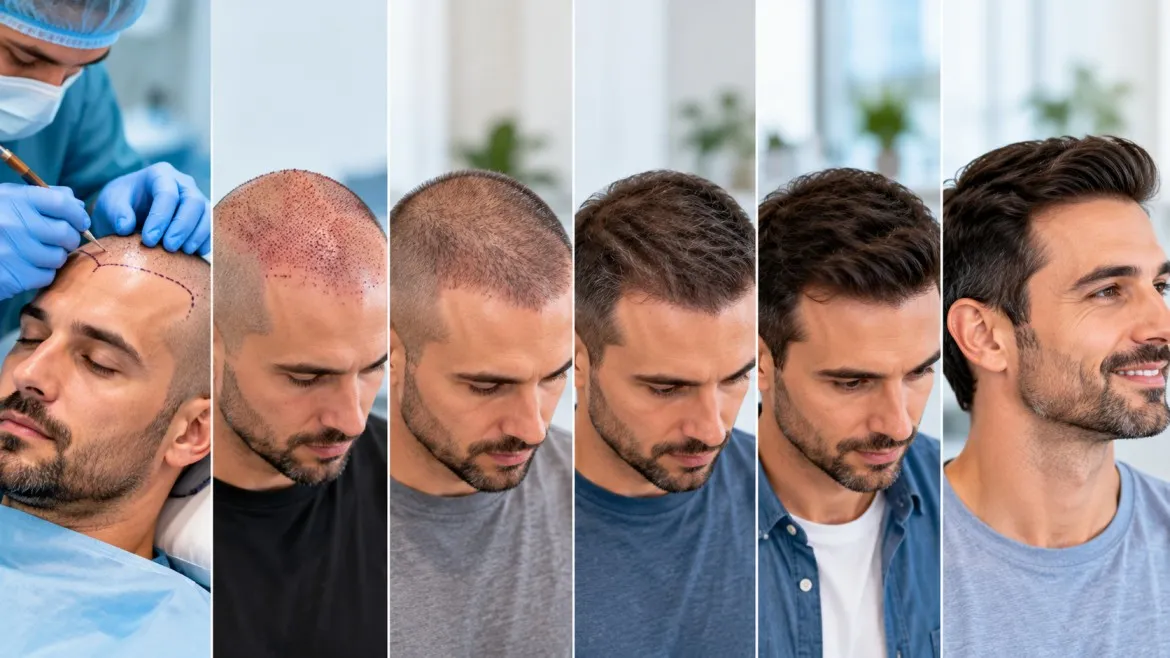
One of the most common questions after a hair transplant is also the hardest to answer in a single sentence: when will I see the result? The honest answer is that it depends on the biology of the hair cycle, and that visible change happens in phases over twelve months or more. Understanding why transplanted hair sheds, rests and regrows helps patients stay calm during the quiet months and judge their progress accurately. This guide explains the science behind the hair transplant timeline, what to expect month by month, and which factors can speed up or slow down the process.
The biology behind the timeline
Hair does not grow continuously. Each follicle cycles through phases: a long growth phase called anagen, which lasts several years; a short transition phase called catagen; and a resting phase called telogen, after which the old hair is shed and a new one begins to grow. At any moment, most scalp hairs are in the growth phase, while a smaller proportion are resting.
A transplant disrupts this rhythm. When follicular units are extracted and implanted, the trauma pushes many of the transplanted follicles into the resting phase. The visible hair shaft falls out in the weeks that follow, while the follicle itself remains under the skin. After a period of rest, the follicle re-enters the growth phase and produces a new hair. This is why a transplant seems to "go backwards" before it moves forward, and why the timeline is measured in months and not weeks.
Week by week: the first month
Days 1 to 3. The scalp is tender, with mild swelling, redness and small crusts at each graft. The forehead may swell in the second or third day, which usually resolves on its own within a few days. Patients follow the washing and sleeping instructions given by the clinic.
Days 4 to 10. Crusts begin to loosen as the patient washes gently. Redness fades gradually. Most patients feel physically comfortable, although the area remains visible.
Weeks 2 to 3. Crusts usually fall away, and the scalp looks cleaner. The transplanted hairs may still be visible, but the shedding phase is beginning.
Weeks 3 to 4. Many patients notice that transplanted hairs fall out. This is normal and expected. Some native hairs near the grafts may also shed temporarily, which is sometimes described as shock loss.
Months 2 and 3: the resting phase
These months are often the most emotionally difficult, because the scalp can look similar to or thinner than before the operation. Patients may wonder whether the procedure has worked, and it is tempting to compare notes online. Reassurance comes from knowing that follicles are resting, not lost. Regular photographs, taken in the same light and angle, will show subtle changes that are not obvious in the mirror.
Clinics often schedule a review during this period, by photograph or video, to confirm that healing is on track and to answer questions. If you experience pain, persistent redness or signs of infection, you should contact the clinic promptly.
Months 3 to 5: first new growth
Between the third and fifth month, new hairs begin to emerge. They are usually fine, short and sometimes lighter than the final hair. Growth may be uneven at first, with some areas appearing earlier than others. Some patients notice small spots or folliculitis as hairs push through, which usually resolves but should be reported if persistent.
At this stage, the improvement is gradual. Hairs thicken and lengthen week by week, though the density is still less than what the final result will show. Avoid judging the outcome at this point, since most of the growth is yet to come.
Months 6 to 9: visible improvement
By the sixth month, many patients see a clear change. Hairs are longer and thicker, and the hairline begins to look more defined. Texture is often still evolving, and newly grown hair may initially be wavier or finer than the surrounding hair, which tends to normalise with time. Coverage continues to increase between the sixth and ninth month, and patients usually feel that the result has become real.
This is also a good moment to talk with the surgeon about complementary treatments. For patients with progressive hair loss, medical therapy may help protect native hair and support the overall appearance. Such treatments must be prescribed by a physician, and the evidence differs between options.
Months 9 to 12: maturation
Over the last months of the first year, hair continues to thicken and the density approaches its final level. By twelve months, the result is usually well established, and the surgeon can evaluate whether the objectives of the plan have been met. In some patients, particularly those with thick or coarse hair, maturation continues up to eighteen months.
Beyond one year
After the first year, the transplanted hair behaves like the hair in the donor area from which it was taken. It generally continues to grow throughout life. The surrounding native hair, however, may continue to thin if the underlying cause of hair loss progresses, which is why long-term planning matters. Some patients choose a second session to increase density or to extend coverage once the first has matured, usually after about twelve months.
A summary of the timeline
| Timeline | Expected Changes |
|---|---|
| Days 1–10 | Healing, mild swelling and redness, crusts at each graft |
| Weeks 2–4 | Crusts fall away; transplanted hairs shed while follicles rest |
| Months 2–3 | Resting phase; the scalp may look similar to before surgery |
| Months 3–5 | First fine, short new hairs begin to emerge |
| Months 6–9 | Hairs thicken and lengthen; the hairline becomes more defined |
| Months 9–12 | Maturation; density approaches its final level |
| 12–18 months | Final result established; slower maturation is possible with coarse hair |
Why timelines differ between patients
The timeline above is typical, but individual variation is normal. Several factors influence how quickly hair grows and how it looks along the way.
How the surgeon's approach shapes the timeline
The speed and quality of recovery are linked to how the operation is planned and performed. A careful surgeon protects the donor area, handles grafts gently, minimises the time they spend outside the body and implants them at the correct angle and depth. At Hairmedico Clinic in Istanbul, led by Dr. Arslan Musbeh, the one-patient-per-day schedule and the Algorithmic FUE planning approach are designed to bring that kind of discipline to each stage. Dr. Musbeh graduated from Odessa State Medical University in 2000, is an active member of FUE Europe, and has taught as a faculty instructor on the DIU Calvitie programme at Université Claude Bernard Lyon 1 since 2019, and the clinic reports more than 4,500 procedures in total, with more than 3,000 performed personally by him.
None of this changes the biology of the hair cycle, which no technique can accelerate dramatically. What a careful approach can do is protect the grafts, reduce avoidable complications and give patients a clear explanation of what to expect at each stage.
Tracking your progress properly
Objective documentation prevents anxiety and misinterpretation. Take photographs once a month in the same place, with the same lighting, angle and hair length, ideally from the front, both sides, the top and the crown. Avoid comparing wet and dry hair, or hair styled differently. Share the images with the clinic at agreed intervals, and ask the surgeon to interpret them in the context of your timeline.
It also helps to keep notes on what you observe, such as when crusts fell, when shedding began and when new hairs appeared. These notes are useful at review appointments and help the surgeon distinguish normal variation from something that requires attention.
When to be concerned
Most of the recovery is routine, but some signs require medical attention. Contact the clinic promptly if you experience increasing pain, fever, spreading redness or swelling after the first days, pus-like discharge, persistent bleeding, or a large number of grafts dislodged early on. Likewise, if you have seen no new growth at all by around six to eight months, discuss it with the surgeon, who may review your progress and consider possible causes.
Frequently asked questions
When can I wash my hair normally? The clinic will give a precise schedule. Typically, patients begin with a gentle, guided wash and progress to a normal routine after the first one to two weeks.
When will I be able to cut or style my hair? The surgeon will advise. Many patients are permitted a light trim after a few months, but this depends on the plan.
Can I exercise? Light activity is usually acceptable early on, while strenuous exercise, swimming and heat exposure are restricted for a period defined by the surgeon.
Is shedding a sign of failure? No. Shedding is a normal part of the cycle, and the follicles remain in place.
Will I need a second session? Some patients do, especially if they have extensive loss or limited donor reserves. The decision is best taken after about twelve months, once the first result has matured.
Can anything speed up growth? No method makes the cycle dramatically faster. Good aftercare, healthy habits and, where appropriate, medical therapy prescribed by a physician support the process.
The bottom line
The hair transplant timeline is a story of patience. The first weeks bring healing, the next months bring shedding and rest, and the visible result arrives gradually through the second half of the first year, with maturation continuing after that. Patients who understand the biology, document their progress and keep in touch with a surgeon they trust, whether at Hairmedico Clinic with Dr. Arslan Musbeh or elsewhere, are better prepared for the process and more likely to be satisfied with the outcome.
This article is for general information only and does not replace individual medical advice. Results vary between patients, and no outcome can be guaranteed.