Residential vs. Commercial Security Systems
By Lois Wilson
62 Views
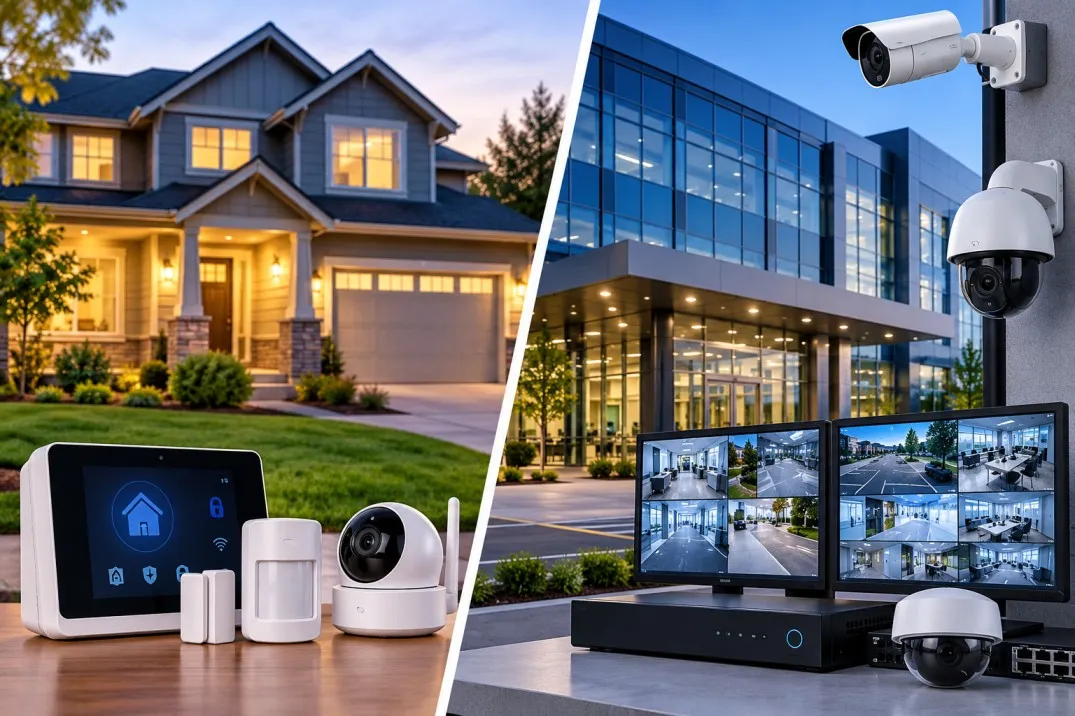
Evaluating physical security requirements involves understanding the operational differences between home environments and commercial facilities. While both residential and commercial security systems share the core objective of protecting property, assets, and occupants, their structural design, technological capabilities, and regulatory compliance requirements differ significantly. Selecting the appropriate system requires analyzing factors such as property scale, user access levels, continuous monitoring needs, and integration capabilities.
Scale, Coverage, and Hardware Requirements
The physical footprint of a property directly dictates the complexity and hardware requirements of its surveillance and alarm infrastructure.
Residential security applications typically focus on protecting immediate entry points, primary living areas, and small outdoor perimeters such as driveways or backyards. A standard home system generally incorporates four to eight cameras, basic door and window contact sensors, motion detectors, and a central hub. Wireless technology is frequently used in residential settings to simplify deployment and minimize structural modifications to walls or finishes.
Commercial facilities, by contrast, present far broader coverage demands. Warehouses, office complexes, retail centers, and industrial yards require expansive surveillance coverage that eliminates blind spots across large square footage. Commercial installations often deploy dozens or even hundreds of cameras, including specialized hardware such as high-definition Pan-Tilt-Zoom (PTZ) units, multi-sensor panoramic cameras, thermal imaging equipment, and license plate recognition (LPR) systems. Due to signal distance, bandwidth demands, and system reliability standards, commercial systems rely heavily on wired Power over Ethernet (PoE) infrastructure and dedicated server racks rather than basic wireless networks.
Access Control and Multi-User Management
User access management represents another major distinction between home and business security architectures.
Residential systems operate on simple access structures designed for family members and occasional guests. System control is usually managed through a single mobile application, touchscreen keypad, or wireless key fob. Granting temporary access—such as for service providers or house sitters—involves creating temporary passcodes or sharing digital app permissions.
Commercial environments demand multi-tiered access control frameworks to manage varying levels of employee clearance across restricted departments, server rooms, executive offices, and loading bays. Integrated commercial access control uses keycards, key fobs, PIN pads, or biometric readers to manage movement throughout a facility. System administrators require granular control to:
- Assign access privileges based on job roles, department levels, or shift schedules
- Instantly revoke access permissions for former employees or contractors
- Maintain comprehensive audit logs tracking exact entries and exits across every secure door
- Automatically lock or release designated doors during specific business hours or emergency evacuations
Regulatory Compliance and Industry Standards
Commercial security installations must adhere to strict regulatory, legal, and industry standards that rarely apply to single-family homes.
Depending on the industry, businesses face mandatory compliance frameworks governing video retention, data privacy, and physical access. For instance, healthcare facilities handling sensitive patient records, financial institutions, and businesses processing credit card transactions must comply with specific physical data protection guidelines. Commercial systems often require encrypted data transmission, secure off-site backups, and strict video storage retention policies ranging from 30 to 90 days or longer.
Furthermore, commercial installations must strictly align with local fire safety codes, building codes, and emergency egress regulations. Door access control hardware installed in commercial buildings must feature automatic release mechanisms tied into the main fire alarm panel to ensure unhindered evacuation during emergencies. Residential systems, while built to safety standards, face far fewer legal retention and regulatory auditing mandates.
System Integration and Monitoring Protocols
The operational goals of residential and commercial security systems dictate how incoming data and alarm signals are processed.
For homeowners, convenience, remote visibility, and ease of use are paramount. A professional residential CCTV installation allows residents to view live video streams, receive push notifications for detected motion, interact via two-way doorbells, and manage smart home integrations, such as lighting or smart locks, from a single smartphone interface. Alarm verification is often self-managed or handled by a consumer-focused central monitoring station that verifies alerts before contacting local authorities.
Commercial security infrastructures prioritize enterprise-level integration, centralized management, and immediate threat verification. Business systems consolidate video management software (VMS), intrusion detection, access control, fire safety alarms, and building automation into a unified platform. In multi-site commercial operations, security teams monitor hundreds of real-time camera feeds across geographically dispersed locations through centralized security operations centers (SOC). Advanced video analytics, such as line-crossing detection, loitering alerts, and automated vehicle identification, assist operators by automatically highlighting suspicious behavior amidst vast visual data.
Choosing the Right Defense Strategy
While both residential and commercial security systems utilize sensors, cameras, and alarms, their underlying architectures serve distinctly different operational needs. Residential setups focus on user convenience, targeted perimeter monitoring, and accessible smart home management. Commercial systems are engineered for continuous durability, extensive scalabilty, multi-user access control, and strict regulatory compliance. Recognizing these technical and structural differences ensures property owners select a security infrastructure tailored to their specific operational scale and risk profile.