The 60-Second Trade: Why Binary Options Went Viral on Social Media
By Abdus Salam
64 Views
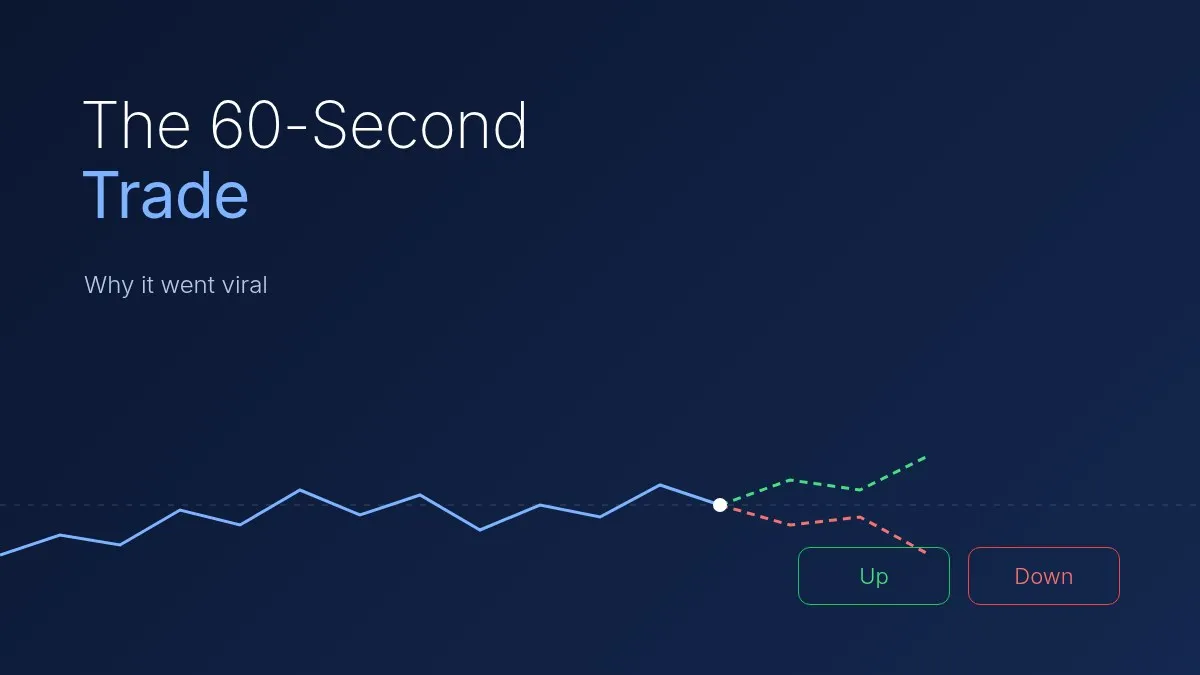
Scroll through short-video apps for long enough and you will see it: a phone screen, a price chart, a big green "UP" button and a balance that jumps in seconds. Sixty-second trades have become a genre of internet content in their own right. But the story behind the clips is more complicated than the highlight reels suggest.
Why the format works so well online
Binary options are almost perfectly designed for short-form video:
- One decision. Up or down. Viewers understand it instantly.
- Instant results. A trade can finish before the video does.
- Clear numbers. The balance changes on screen, which makes for an easy hook.
- Low barrier. Many platforms accept deposits of $10 and trades of $1.
That combination creates the same tension as a sports penalty or a game show. Algorithms reward content that keeps people watching, and a ticking 60-second timer does exactly that.
What the clips do not show
The biggest problem is selection. Creators can record dozens of trades and post only the wins. Some use demo accounts that look identical to real ones. Others earn affiliate commissions when viewers sign up, which means they profit whether or not their followers do.
The underlying maths rarely appears on screen. A typical payout is 80–92% of the stake, while a loss costs 100%. That means a trader needs to win roughly 52–56% of trades just to break even. Over 60 seconds, price moves are close to random, so the long-run result for most players is a slow loss.
The psychology behind the button
Short trades tap into the same reward loops as mobile games. Each result arrives quickly, wins feel exciting and losses feel easy to "win back" with the next trade. Bright colours, sound effects and countdown timers reinforce the habit.
This is why many traders place far more trades than they planned. Ten one-minute trades become fifty, and small stakes slowly grow as people try to recover losses. Behavioural researchers call this loss chasing, and it is one of the main reasons short-term traders end up with larger losses than expected.
Setting rules before you start — a maximum number of trades, a fixed daily budget and a hard stop after a set loss — is the simplest way to stay in control.
Regulators have noticed
Authorities in the EU, the UK and Australia have banned the sale of binary options to retail clients. Several regulators have also warned about "finfluencers" promoting unlicensed brokers, and some have issued fines. Despite that, offshore platforms continue to advertise globally, and the content keeps spreading.
How to watch trading content with a critical eye
If these videos keep appearing in your feed, a few questions help separate entertainment from advice:
- Is it a real account? Demo balances often look the same.
- Are losses shown? A creator who never loses is not showing the full picture.
- Is there an affiliate link? If so, the creator earns from your sign-up.
- Is the broker regulated where you live? Check your national regulator, not the video caption.
- What do independent reviews say? Sites such as binaryoptions.app list regulator warnings, payouts and withdrawal rules for popular brokers.
The bottom line
The 60-second trade went viral because it is simple, fast and visual — not because it is a reliable way to make money. Treat the clips as entertainment, run the numbers yourself, and if you are curious, start with a free demo account rather than real money.
Trading binary options carries a high level of risk.
Related Reading
Why Business & Finance is Transforming the Global Industry Landscape
Welcome to our in-depth exploration of Business & Finance. In an era defined...
Why Business & Finance is Transforming the Global Industry Landscape
Welcome to our in-depth exploration of Business & Finance. In an era defined...